
Course overview
AgileBA® bridges the gap between traditional business analysis and agile delivery. It provides a practical framework for understanding business needs, shaping requirements, engaging stakeholders, and supporting solution delivery within agile environments.
Based on the proven DSDM Agile Project Framework, AgileBA helps organisations ensure that change initiatives remain focused on business value, customer outcomes, and stakeholder needs while maintaining the flexibility and responsiveness expected of agile delivery approaches. Rather than treating business analysis as a separate upfront activity, AgileBA integrates analysis throughout the project lifecycle, enabling continuous collaboration, prioritisation, validation, and refinement of requirements.
The AgileBA certification equips professionals with the knowledge, techniques, and practical skills needed to work effectively as Business Analysts, Product Owners, Change Professionals, Project Managers, and Agile Team Members. Participants learn how to define and manage requirements, facilitate stakeholder engagement, support iterative delivery, and ensure that business solutions remain aligned with organisational strategy and benefits objectives.
Why AgileBA Matters
Many organisations have adopted agile delivery methods but continue to struggle with:
- Poorly defined requirements
- Stakeholder disengagement
- Unclear business outcomes
- Scope uncertainty
- Prioritisation conflicts
- Solutions that fail to deliver expected benefits
AgileBA addresses these challenges by combining proven business analysis disciplines with agile principles and practices. It helps organisations move beyond documenting requirements toward actively shaping value delivery throughout the lifecycle of change initiatives.
The framework emphasises:
- Business value over documentation
- Continuous stakeholder collaboration
- Iterative requirements development
- Outcome-focused decision making
- Adaptive planning and prioritisation
- Benefits-led delivery
For organisations undertaking digital transformation, service redesign, process improvement, customer experience initiatives, or enterprise change programmes, AgileBA provides a practical toolkit for ensuring that delivery teams remain aligned to business objectives from concept through to benefits realisation.
Who Should Take This Course?
This course is ideal for:
- Business Analysts
- Agile Team Members
- Product Owners
- Product Managers
- Project Managers
- Change Managers
- Transformation Professionals
- Process Improvement Specialists
- Business Consultants
- Service Designers
It is particularly valuable for professionals working in organisations transitioning from traditional delivery approaches to agile ways of working.
The AgileBA syllabus is structured around four core capability areas: Agile Business Analysis Fundamentals, Strategy & Organisation, Agile Practices, and Requirements Management.
Agile Business Analysis Fundamentals
Participants learn how to:
- Analyse business environments using PESTLE, SWOT, TOWS, MOST, Value Chain and Lean techniques
- Understand organisational change drivers
- Apply DSDM Agile principles and lifecycle concepts
- Work effectively within Agile project governance structures
- Support business analysis activities across project phases
Strategy and Organisation
Participants learn how to:
- Develop business cases and Lean Canvases
- Align change initiatives with strategic objectives
- Perform stakeholder analysis and engagement planning
- Create stakeholder personas and customer journeys
- Facilitate collaboration across business and delivery teams
Agile Practices
Participants learn how to:
- Facilitate effective workshops
- Use modelling and prototyping techniques
- Support iterative development approaches
- Apply structured and free-format timeboxing
- Improve collaboration and communication across teams
Requirements Management
Participants learn how to:
- Elicit and validate requirements
- Write effective User Stories
- Apply INVEST criteria
- Use MoSCoW prioritisation
- Develop acceptance criteria
- Manage requirements throughout the agile lifecycle
- Support testing and solution validation activities
SFIA Capability Alignment
AgileBA aligns strongly with several SFIA capabilities commonly required across business analysis, transformation, project delivery, and organisational change roles.
| SFIA Skill | Level Alignment |
|---|---|
| Business Analysis (BUAN) | Levels 3–6 |
| Requirements Definition & Management (REQM) | Levels 3–6 |
| Stakeholder Relationship Management (RLMT) | Levels 4–6 |
| Organisational Change Management (CIPM) | Levels 4–6 |
| Business Process Improvement (BPRE) | Levels 4–6 |
| Enterprise & Business Architecture Support | Levels 4–5 |
| User Experience Analysis (UNAN) | Levels 3–5 |
| Benefits Management (BENM) | Levels 4–6 |
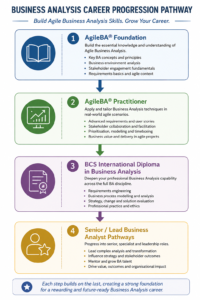
AgileBA is particularly valuable for professionals seeking progression into senior Business Analyst, Lead Business Analyst, Product Ownership, Change Management, and Transformation roles.
Behavioural Capability Layer
Beyond technical business analysis skills, AgileBA develops critical behavioural competencies increasingly sought by employers.
Strategic Thinking
- Understanding business drivers
- Aligning delivery with organisational objectives
- Evaluating benefits and outcomes
Stakeholder Influence
- Facilitating collaboration
- Managing competing priorities
- Building consensus
Customer Focus
- Customer journey mapping
- User-centred requirements
- Value-driven delivery
Analytical Thinking
- Root cause analysis
- Problem definition
- Structured decision making
Adaptability
- Responding to changing priorities
- Managing evolving requirements
- Supporting iterative delivery
Communication & Facilitation
- Workshop leadership
- Active listening
- Requirements communication
These capabilities complement frameworks such as SFIA, the NHS Knowledge and Skills Framework, organisational capability frameworks, and leadership development programmes.
AgileBA certification is increasingly relevant for professionals working in:
Business Analysis
- Business Analyst
- Senior Business Analyst
- Lead Business Analyst
- Principal Business Analyst
Agile Delivery
- Product Owner
- Product Manager
- Agile Business Analyst
- Scrum Team Member
Project & Change Management
- Project Manager
- Agile Project Manager
- Change Manager
- Transformation Manager
Strategy & Improvement
- Process Improvement Consultant
- Continuous Improvement Lead
- Digital Transformation Specialist
- Service Design Practitioner
Employers frequently seek skills in:
- Requirements elicitation
- Stakeholder engagement
- User story development
- Prioritisation techniques
- Agile delivery support
- Customer journey mapping
- Business case development
Check session details for course timings. Full-time courses are generally held: Monday - Friday 09:30 - 16:30
There is required pre-reading and knowledge check for course attendance.
FAQs